

A Therapist's Take on Chongker's Companion Cats
By Matthew McLean, California LMFT No. 115650
Disclosure: Chongker provided products for evaluation, and I was paid a small fee to write this honest post. The experiences and opinions shared here are my own.
There is a cat next to me on the couch. I'm reading, and without giving it much thought, I reach over and pet it. My hand stays there for a while.
This would be an ordinary evening, except that the cat isn't real.
I know this, of course. I'm a psychotherapist, and reasonably clear on the distinction. Still, the fur feels lovely, and there is something reassuring about that solid little furball beside me. I keep reading. I keep petting. As someone who has owned and loved cats, and also has allergies, I find this arrangement quite appealing.
I've been spending time with three Chongker companions: a weighted tuxedo cat, a somewhat larger robotic cat that responds to touch with sounds and movement, and a nonmoving "Percy" model, which has just arrived at my door in yet another box. Cats love boxes, so this makes sense. I am approaching this with a therapist's curiosity, wondering whether they might be useful to some of the people I work with. I've also found myself enjoying them simply as someone who misses having a cat around.
The tuxedo has claimed the couch
The weighted tuxedo is my favorite. There, I've said it. Hopefully, the robotic cats aren't reading this.
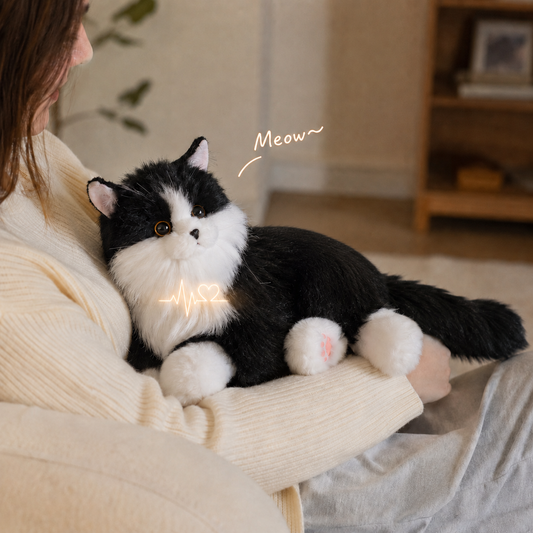
What won me over was the feel. The fur is soft, and the weighted filling gives the body a substantial, yielding quality. Pick it up or settle it in your lap, and there is something familiar about the experience. The weighted cat lends itself to this. The other two would be fine in your lap but too big to put on your chest. (Please be sure to follow your doctor's guidance about picking up something that weighs three pounds and putting it in your lap or on your chest. Some people should not do this.)
This is the three-pound version. [1] Initially, I thought I wanted it to be larger, remembering some of the rather substantial cats I've known. But the more I've enjoyed having it nearby, the more I've come to appreciate the size. It is just right.
Its lower front legs move freely, while the upper front legs and rear legs are incorporated into the body. That gives it the compact shape of a cat settled in for a rest. It fits comfortably beside me or in my lap. I've also enjoyed resting it on my chest while awake and reading, much as a real cat might sit there. Unlike some cats I've known, it has yet to position itself directly between my face and the book.
Mostly, I appreciate how easily it becomes part of a quiet evening. I don't have to do anything in particular. It's simply there, within reach, and I'm surprised by how much I enjoy that. It's not alive, so it can't be an actual companion, but its presence is nonetheless comforting.
The robotic cats would like a word
The robotic models each have a different personality - or, more accurately, each gives a different impression of one.
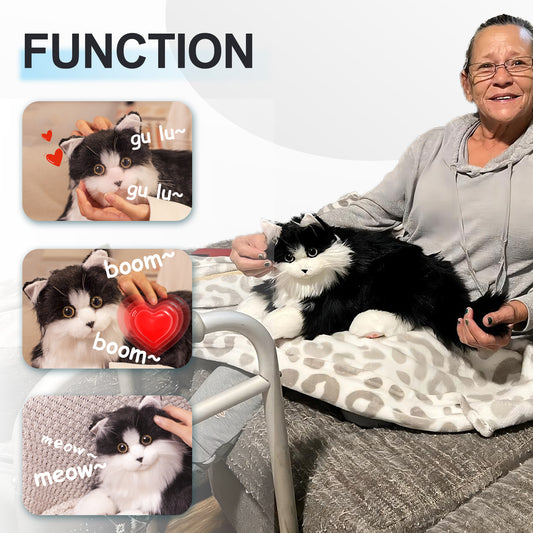
The MateCat 1.1 I evaluated responds to petting with sounds, including meows and purring, and has a simulated heartbeat and head and tail movement. [2] You interact with it, and it responds. That little exchange is engaging.
One behavior particularly caught my attention. After I've played with it and gone back to something else, it meows intermittently a few times over several minutes. It sounds like an invitation to keep it company. Anyone who has lived with a cat will recognize this attitude toward being ignored.
The MateCat is larger and bulkier than the weighted tuxedo. Percy, also a tuxedo, is larger than the weighted cat too, but feels less bulky than the MateCat and has no head or tail movement. [3] The MateCat's internal mechanical components make it feel less soft and yielding, and there are mechanical sounds when it moves. Those differences explain why I reach for the weighted cat when I want quiet company. Sometimes, though, the robotic cat's purring is just right.
Percy, which I have just started using, seems to strike the perfect balance between the two: it meows and purrs and has a simulated heartbeat. Touching its back for a couple of seconds triggers the heartbeat. There are no movement-related motor sounds. To me, this makes it more lifelike in feel, bulk, and sound. Its best trick, however, is that it responds to its name, which is Percy by default. Say its name, and it meows! So cute! The name can be changed easily, if desired. [3]
Percy Interactive Robot Cat Companion for Seniors

The people these cats bring to mind
Earlier in my career, I facilitated an elders' therapy group in an assisted living facility. I loved that work. Residents often told stories about beloved pets they had lost or couldn't bring with them. Those animals had been part of their homes and, in some cases, their daily lives up until they moved into the facility. Their absence was felt.
One resident had a stuffed animal (a floppy dog) and would absentmindedly pet it while it sat in his lap during the group. I sometimes think about those times when I catch myself petting the tuxedo. There is something comforting about just reaching over and petting it. It is a feeling I remember well. For years, my cat allergies had seemed much less noticeable while I lived with cats. I no longer do, and these days I notice them again, although they are mild.
Professionally, trauma, grief, and loneliness surface in my work almost every day. Much of therapy involves talking, but I also pay attention to what helps someone feel comfortable enough to be there - to settle into the session and take their time. A soft animal in someone's lap might have a place in that. Psychology has long taken comforting objects and play seriously. Winnicott explored their emotional significance in Playing and Reality. [4] But you don't need a psychology book to appreciate the comforting feeling of holding something soft.
The tuxedo is resting on my chest as I type this, and the weight makes it feel as though I have a cat on my chest. Bonus: I can breathe!
Where comfort might fit
Imagine someone holding the weighted cat during a difficult conversation in therapy. They notice its weight in their lap and the fur beneath their fingers. For a moment, they pay attention to what they can feel, here in the room. That could become part of grounding, which means bringing attention to present sensations and surroundings. [5] It's a possible use, rather than an established treatment protocol for these cats, and it should always be the person's choice whether or not to pet or play with the cat.
Or imagine visiting an elder who has always enjoyed cats. You introduce the companion, set it beside them, and see what happens. Perhaps they stroke it. Perhaps a story comes to mind. Perhaps they decide it needs a name. If they have a Percy model, they can give it a new name and have it respond when they call it. [3] If they have the weighted one, it won't respond, but it looks very cute, and to me it feels like the nicest of the three. It's also the smallest.
The robotic cat's meowing might invite someone back to an interaction after their attention has wandered. That possibility interests me. For someone else, the same sound might be irritating. I would sit with them and see. If they enjoy it, lovely. If they don't, we can put it away.
And I would introduce it honestly. These are artificial companions, not living, trained, or certified therapy animals. They can offer something pleasant alongside care and human connection; they cannot take their place.
Something to have nearby
I would never offer an artificial cat as a replacement for a pet - or a person - someone has lost. I might offer it as something they could enjoy having nearby. That distinction matters. Grief is personal, and a resemblance to a beloved animal might feel comforting to one person and painful to another. I would ask before choosing one for someone. Of course, you don't have to be grieving or lonely to enjoy one. A quiet evening with a good book is reason enough.
I don't work with children, so I'll leave specific therapeutic recommendations in that area to professionals who do. Still, I can easily imagine a child loving one of these companions.
Practical thoughts
My own preference is for the weighted tuxedo's softness and body feel. Someone who enjoys an animal that responds to them may prefer the MateCat or Percy. I do like that Percy purrs when I pet it. In a care facility, check its policies and requirements before sharing any of the cats.
Weight and placement deserve some thought, too. If someone has breathing difficulties, fragile skin, limited strength, or trouble moving the cat independently, ask a clinician or occupational therapist about suitable use and supervision. My experience resting it on my chest is personal, not a recommendation for everyone. Guidance for weighted blankets emphasizes individual assessment and safe removal - sensible considerations to discuss for a weighted companion as well. [6] For children, follow the manufacturer's age and supervision instructions. Keep these and similar companions out of infant sleep spaces. [7]
As for me, the tuxedo has earned its place on the couch. I still enjoy the MateCat, and I especially like Percy's purring, but the weighted one has become a welcome companion while I read.
Every so often, I look down and realize I'm petting it again.
I think that says more about my experience than any list of features could.
Bibliography
- Chongker. (n.d.). 3lbs Tuxedo Handcrafted Weighted Plush - Realistic Companion Cat for Adults. Product specifications and care instructions. https://chongker.com/products/weighted-black-cat-4-5lb
- Chongker. (n.d.). Percy Companion - Interactive Robot Cat (MateCat 1.1). Product features. https://chongker.com/products/matecat10-interactive-cat
- Chongker. (n.d.). Percy Interactive Robot Cat Companion for Seniors (Percy Essential). Product features, customizable name, and care instructions. https://chongker.com/products/percy-interactive-cat
- Winnicott, D. W. (2005). Playing and Reality (2nd ed.). Routledge. (Original work published 1971.) ISBN 9780415345460. https://www.routledge.com/Playing-and-Reality-2nd-Edition/Winnicott/p/book/9780415345460
- U.S. Department of Veterans Affairs, National Center for PTSD. (n.d.). Be in the moment. PTSD Coach Online. https://www.ptsd.va.gov/apps/ptsdcoachonline/tools/be-in-the-moment/pages/page-1.html
- Royal College of Occupational Therapists. (2023). Weighted blankets for children and adults: A guide for occupational therapists. https://www.rcot.co.uk/media/649/download?attachment=
- U.S. Consumer Product Safety Commission. (n.d.). Safe Sleep - Cribs and Infant Products. https://www.cpsc.gov/SafeSleep


