

New to Rosie’s Story?
This article continues Rosie Dantès’ personal journey with therapeutic companion technology.
If you’re new to Rosie’s story, we recommend starting with her previous experiences:
Finding Comfort in the Unexpected: A Caregiver’s Journey with Robot Therapy
In Part One, Rosie shares how she first discovered therapeutic robot animals while caring for her mother during her battle with ALS, and how an unexpected bond with a Chongker companion helped her navigate anxiety, burnout, and the overwhelming responsibilities of caregiving.
Something to Hold: How Therapeutic Robot Animals Can Help Us Grieve
In Part Two, Rosie explores how robotic companion animals provided comfort and emotional grounding during grief after losing her mother, while examining the research behind why these companions can feel meaningful during difficult life transitions.
From Social Fatigue to Human Connection
In Part Three, Rosie explores social fatigue, emotional recovery, and the ways supportive technology can create a low-pressure space to recharge, reconnect with yourself, and gradually reconnect with others.
Continuing the Journey
In this article, Rosie turns her attention to another important area of companion technology: Alzheimer’s care.
Drawing from her own experience as a full-time caregiver for her mother with ALS, as well as research into animal-like socially assistive robots, she explores how touch, simulated heartbeat, purring, breathing, and simple social interaction may offer comfort and connection for people living with Alzheimer’s—and for the caregivers supporting them.
This is Rosie’s story, informed by both personal experience and the research she discovered along the way.
Living with or alongside someone with a neurodegenerative disease is a cycle of constantly adapting to changes and challenges that can be hard, if not impossible at times, to communicate to anyone else. I can’t speak to what that experience is like for someone with Alzheimer’s, but I was a full-time caregiver for my mom who had ALS, another neurodegenerative disease.
Alzheimer’s takes a different path than ALS, but the need to continually adapt—to changes in movement, independence, communication and how we connect—is something I understand.
I actually bought my first robot cat to help manage my mood, anxiety and overall caregiver burnout. Before I did, I spent months researching animal-like therapeutic robots, and I kept coming across research on their use with people with Alzheimer’s disease and dementia. I had no idea at the time just how much something as seemingly simple as a robot cat could potentially offer someone living with Alzheimer’s.
That’s what I’m here to talk about today. Stick with me.
Beyond Physical Needs.
Alzheimer's disease is a neurological condition that gradually affects a person's ability to think, remember, and carry out everyday tasks. As the disease progresses, it continues to damage the brain's communication networks as brain cells degenerate and die. This progression can lead to dementia, a stage in which changes in thinking and memory significantly interfere with a person's independence.
The need for emotional and social support becomes especially important whether an individual is receiving care at home or living in a formal care setting, such as a nursing home, assisted living facility, or hospital.
Because clinical care settings often focus primarily on physical health, a person's social and emotional needs can easily be overlooked. Animal-like socially assistive robots (SARs) offer a way to make these environments more comforting while enhancing the overall quality of life for individuals living with Alzheimer's disease and their caregivers.
The benefits of animal therapy– with robot animals.
Plush bodied animal-like (and “huggable”) SARs have been shown to provide many of the benefits seen in live animal therapy (4) and can be a strong alternative when live animals aren't available.
Years of research have shown potential benefits that include reducing loneliness and social isolation, increasing social engagement, improving sleep and mood, and reducing anxiety, stress and pain.
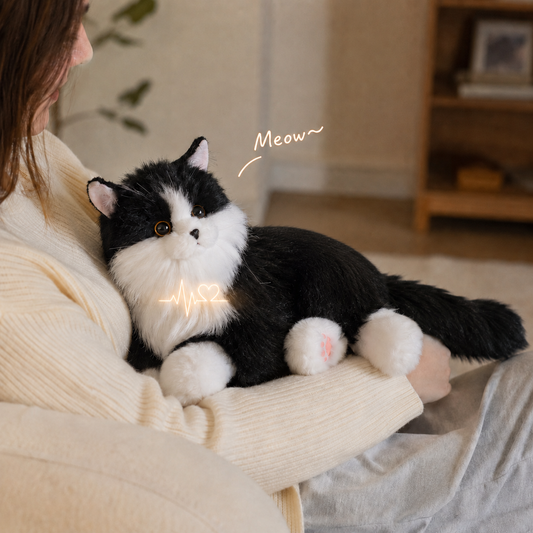
Two “huggable” SARs, Chongker’s Percy Essentials—the Percy 1.1 and 2.0 (both of which I own and use)—offer tremendous potential to support the social, emotional and behavioral needs of individuals with Alzheimer’s disease.
Let me explain.
Technology to Touch.
As verbal communication and abstract thinking become more difficult during the course of Alzheimer's, an individual’s sensory processing as a whole is also affected. Things like bright lights, busy rooms and conversations between multiple people can cause sensory overload as the brain struggles to handle everything coming at it at once.
Hidden is a small blessing.
A person’s sense of touch remains largely intact well into the advanced stages of the disease. Physical touch can be grounding—a connection that asks very little while communicating safety and comfort, without the person having to figure out speech or body language (5). Regular, gentle touch can help decrease restlessness, sudden anger, wandering and anxiety that can accompany sensory overload (26).
There can be help around the corner (with soft fur) to combat these challenges. (“Challenges” being an understatement, especially for those of you directly affected by them).
The direct connection between touch and emotional regulation is one reason why “huggable” animal-like SARs like the Percys can be so beneficial. Getting a robot early in the disease, while a person still has more independence, may give them a comforting, grounding tool to reach for on their own when they’re feeling frustrated or overwhelmed.
Time for some specifics.
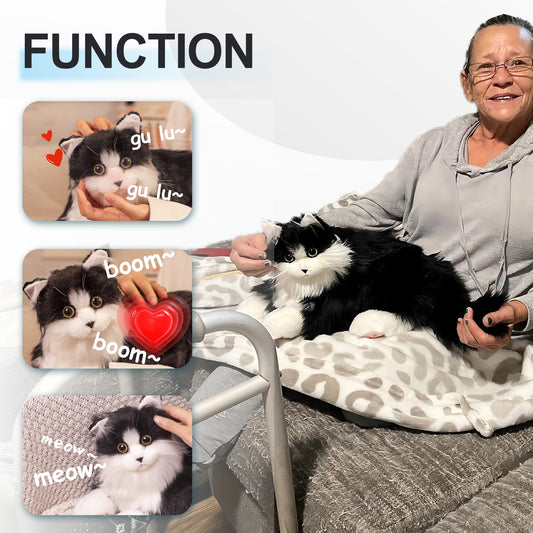
When touching a purring Percy, the person can physically feel the micro-vibrations, which can promote relaxation and decrease agitation, panic and anxiety. The human body naturally synchronizes to calm, steady rhythms around it (22). Physically feeling the pum-pum of the simulated heartbeat, especially directly against one's chest, can help the body's own rhythm sync with the steady heartbeat and stabilize heart rate. This can help ease overwhelm and decrease restless wandering.
As a person’s mobility becomes progressively more limited during the course of Alzheimer’s disease, Percy’s sensitive touch sensors can respond to even a gentle pat on the back with meows and purrs, requiring very little effort from the person to receive a response. Percy’s heartbeat starts when you hold down the back sensor and requires only light pressure to keep it going.
Whether with a caregiver’s assistance or independently, resting a hand, wrist or arm over the back of the cat allows a person to feel the continuous heartbeat without much effort.

A deeper rhythm.
In breathing mode, the Percy 2.0’s back gently rises and falls alongside a steady purr. Holding the Percy to your chest or placing your hands on its chest as it gently rises and falls can guide your breathing into a slower, deeper rhythm. The breathing movement provides a physical cue that can help guide breathing without spoken instructions (6).
Slower breathing helps the heart and brain work more efficiently. It increases heart rate variability—the natural flexibility in how the heart speeds up and slows down—which improves oxygen delivery throughout the body. Improved oxygen flow throughout the body may also help lower inflammation within the central nervous system, which can contribute to better overall brain health and resilience (6).
What we’ve learned from “The Godfather” seal.
Animal-like SARs like the Percy 1.1 (and the Percy 2.0) respond to you in ways that can create a sense of social interaction. For example, if you say its name, it replies with a meow. If you pet its back, it responds with a soft vocalization. It’s an active social exchange, and little by little these interactions can create and deepen a bond with the robot itself. As that bond grows, it may strengthen the benefits of interacting with the robot and encourage more positive social interactions with other people.
A Percy can give people something to connect over—a conversation starter, an ice breaker or even a comforting ‘buddy’ to talk to (7). Researchers using the PARO seal in studies have frequently seen these social effects.
PARO has been the most frequently used animal-like SAR in research with people with Alzheimer’s and dementia for over a decade. I’ve said it before and I’ll say it again: I consider it “The Godfather” of huggable animal-like SARs to date.
I should probably give it a proper introduction.
PARO is currently an FDA-certified medical device with a base price of around $6,000 USD, making it less accessible to the average consumer. The good news is that PARO studies have helped open the door for further research into “huggable” animal-like robots and the development of new robots at more accessible prices.
PARO is a plush robot designed to look like a baby harp seal. Built-in touch, light and auditory sensors (microphones) allow PARO to detect and respond to a user’s interactions.
A 2016 Australian study looked at how PARO affected residents in an aged care facility, including those with Alzheimer’s and dementia (4). During interviews, recreational therapists at the facility shared several observations about how residents responded to PARO (4).
Therapists described seeing a “deepening of relationships between therapists and the residents” (4). They also saw stronger connections develop between residents and other care staff and family members. During one group activity, residents worked together to make lyrics about PARO using a “familiar old tune”. They laughed, talked over one another and were even seen “elbowing each other” as they engaged with one another (4). The activity had stimulated residents thinking, creating and positively interacting with one another (4)!
Researchers also observed a calming effect among some residents who had been engaging in loud or disruptive behaviors, noting that they “became more relaxed, contented, and settled for a period of time” (4).
This calming response translates over thinking about the Percy models, which haven't been formally studied in this way, but features like its responsive purring, touch interaction and simulated heartbeat share valuable feature connections.
Percy’s potential for people with Alzheimer’s.
The Percy Essentials share many features with other animal-like SARs, while some of their own design choices keep the interaction simple—an important consideration in Alzheimer’s care.
Unlike robots like PARO, neither the cat nor dog version of the Percy 1.1 moves, while the Percy 2.0 cat moves only in its breathing mode. This limited movement means fewer unpredictable sources of stimulation for a person with Alzheimer’s who may already be sensitive to sensory overload.
Both the Percy 1.1 and 2.0 also have a simple volume control that can keep their meows and purrs quiet.
My Percy 1.1’s name is Luna and “her” periodic meow, purr or sigh have a little sense of autonomy to it—almost like a real cat has decided, on its own, to affectionately give me some attention even when I’m not actively petting her. I can’t help but crack a smile when she sighs. That’s my favorite.
One last study (I promise!) asked healthcare professionals for their thoughts on using animal-like robots with people with dementia (11).
Some participants felt that a robotic cat or dog might be more familiar and relatable than a seal because of people's experiences with household pets. I understand that reasoning which is one reason I find the cat and dog designs of the Percys so comforting.

Never give up.
Living with Alzheimer’s—and loving someone who has Alzheimer’s—means adapting again and again as things change. But changing how we connect doesn't make our connections any less meaningful. At any stage of the disease, moments of comfort and calm can come from something as simple as soft fur beneath your hand, a familiar sound or a comforting rhythm. Look for ways to reach one another. You will find them.
Companions Mentioned in This Story
The companions below were personally used, tested, or discussed by Rosie Dantès throughout her experience with therapeutic comfort technology.
Percy Interactive Robot Cat Companion for Seniors

Breathing Calico Percy 2.0- Heartbeat Pur,Voice Robotic Cat

Transparency & Supporting the Author
At Chongker, we deeply value the voices of caregivers, educators, healthcare professionals, and advocates who help shape our understanding of comfort, companionship, and emotional wellbeing.
The product links above are Rosie Dantès’s personal affiliate links.
If you choose to purchase through these links, Chongker will pay a commission directly to Rosie Dantès at no additional cost to you.
By using these links, you are directly supporting:
- A special education teacher
- A dedicated caregiver
- A mental health advocate
- A writer who has generously shared her personal experiences with grief, caregiving, and healing
We are grateful for her honesty, vulnerability, and willingness to help others feel a little less alone.


