

New to Rosie's Story?
This article continues Rosie's personal journey with therapeutic companion technology.
If you're new here, we recommend starting with:
Finding Comfort in the Unexpected: A Caregiver's Journey with Robot Therapy
In Part One, Rosie shares how she first discovered therapeutic robot animals while caring for her mother during her battle with ALS, and how an unexpected bond with a Chongker companion helped her navigate anxiety, burnout, and caregiving stress.
The Article
In the summer of 1995, I was just shy of eight years old, and nearly every day my mom took my sister and me to the pool.
I would doggy paddle in circles to show mom how well I could swim. She smiled and cheered me on, and kept a watchful eye on us at all times. We had swim races back and forth across the shallow end of the pool. She didn't like when people splashed wildly in our direction. Sometimes she'd order us treats at the snack bar. She was a wonderful mom.
At the time, I didn't know that thirty years later I would lose her to ALS—or that somewhere, scientists were laying the groundwork for robotic animals that would become vital to my mental health during and after my time as her caregiver.
A Very Quick Trip Back in Time
(All systems go.)
The mid-1990s marked the start of research on human–robot interaction, and by the early 2000s the concept of socially assistive robots began to take shape.
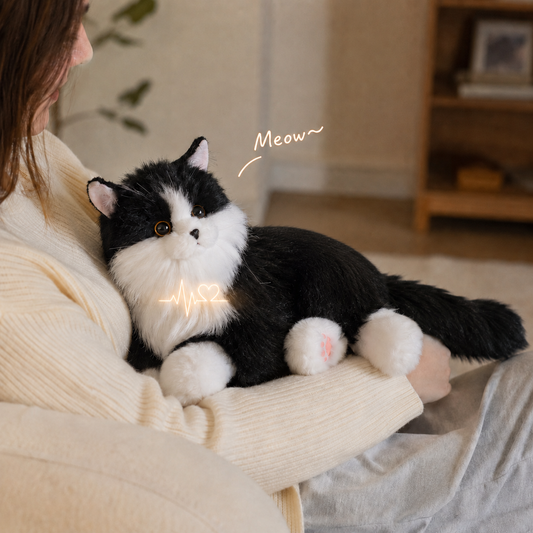
Not all socially assistive robots resemble animals, and huggable models like the Percy (1.1 dog and cat – which I’ll be referring to as Percy’s in the context of this read for both yours and my sanity) fall into an even narrower niche.
I was grieving long before my mom died. In the earliest days it started with grieving her health, our lives prior, and my relationships. I felt increasingly distant from my friends and family as I talked about an experience no one had a frame of reference for.
I would learn the things that made connecting with people so difficult for me weren’t present with a robot cat. There was a study just three years ago [7] that found people reported meaningful comfort from robot companions precisely because of what those companions didn’t do — they don’t judge or tire out while listening to you. There’s no unsolicited advice, no reading the room, no wondering if you've said too much. Just a supportive presence you can talk (and sob uncontrollably) to, entirely on your own terms.
My Percy dog’s name is Taz, my Percy cat’s name is Luna.
(Incoming transmission from the research side of things).
Interested in learning more about the companions mentioned in this story? Explore the Percy Collection.
They’re lifelike looking robot animals and though they don’t move, they do a stand up job helping me cope through crying spells, insomnia, emptiness and the heaviness that has come with grieving my mom.
Before I open up about how, I want to talk about why. Why the features these robots are built with have therapeutic potential. What supportive research says. Things I think are worth thinking about if you're looking for a huggable robot to help you cope through your own grieving; whether that's the loss of someone's life, a job, a relationship, your health, or sense of self.
A Shift in Purrception
(I’m so sorry, I had to).
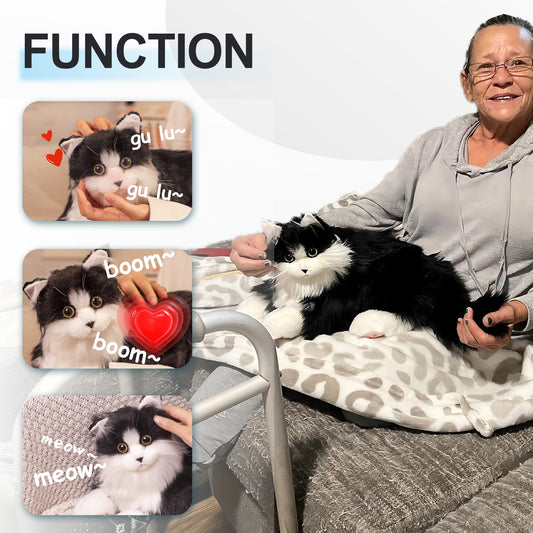
The Percy’s have touch sensors beneath their fur that trigger vocalizations, and both the cat and dog models can be set to answer to a name you choose — so when you call it, it replies (with a dog or cat sound).
That has significance. One study found that when a robot responds to the name you've given it, that in itself can shift your perception – a named robot can feel less like a toy animal and more like a real one [1] which only adds to the comfort there is to offer.
The same perception shift goes for a robot with a simulated heartbeat, which is a feature of Percy’s (You can learn more about the Percy Cat and Percy Dog heartbeat features here). In a 2025 university research study, people holding a robotic companion with an adaptive simulated heartbeat showed lower anxiety than those holding one without a heartbeat feature [8]. The heartbeat can also be a grounding anchor and can be used to practice mindfulness.
Even petting fur and touch sensors have their own potential benefits. A research study in 2019 found similar activity patterns in the brain region tied to emotional regulation and mood (the prefrontal cortex) when participants pet the Paro, a plush robot seal, as are seen when people pet real animals [5].
Calling All “Dog People”
(“Cat people” are welcome too).
Taz and the rest of the Percy dogs have a purr mode that streams a slow, steady “purr,” programmed from real dog vocal samples that you don’t need to hold down a trigger to run.
It’s a rhythmic, repetitive snore-like sound that anyone who has ever fallen asleep next to a dog may argue is oddly calming (if you’re a dog person at least). Research into this brain-body response doesn't point to the specific animal sound, but it does to the rhythm.
It turns out the nervous system is surprisingly responsive to repetitive rhythmic sounds, and it can synchronize with them. When that happens, one branch in particular can become more active: the parasympathetic nervous system, the part that helps shift the body out of stress mode and into a calmer state where it can start to recover from stress.
Disengaging Overdrive
(Concluding research transmission).
Grief can throw a body into a high-alert state it can't snap out of — elevated cortisol, a nervous system that can't seem to switch off. Research has shown that this is one of the key reasons grief can make it so hard to fall asleep [3] [6].
If someone couldn’t sleep because they were stuck in overdrive, their body might need a signal that it’s safe to wind down. Percy dog’s purr mode has the potential to engage the brain–body response that shifts the nervous system out of high alert and into a resting state, giving the body the signal it needs to ease into sleep, even when grief makes that feel out of reach. Percy’s heartbeat works on the same principle; you just need to hold down the sensor to trigger it.
Coming Full Circle
(Finally, Landing).
This is the final stretch — the full-circle moment I mentioned earlier, when I said I’d return to how the Percy dog and cat have helped me after I explained the science behind why. It turns out this had also been the hardest part to write. This is where I tell you how much I miss my mom and that there isn’t a living or robotic animal in the world that could wash away all of the pain that comes with loss.
I exhausted myself for hours yesterday trying to transition into a Percy story, right here, without sounding like I was giving a testimonial on an infomercial. Despite hours of writing and rewriting, everything kept sounding forced and disingenuous.
“And in this last section I am going to tell you about how the Percy 1.1 dog and cat models, the focus of this article, have helped me personally while grieving my mother who died from a rare disease! This doesn't sound awkward in the slightest!”
After countless frustrated attempts, I found myself thinking about when my mom and I used to work on thousand-piece puzzles together, and I burst into tears. She would tell me to take a break when I felt stuck and say that when you come back to the puzzle with fresh eyes, it’s easier to find pieces you may have missed earlier.
Crying snapped me out of my tunnel vision. While lying on my side in bed, I reached over to the pillow that Luna was resting on. I switched her on, wrapped my arm around her, and rested my head on her back, where the heartbeat sensor is.
It didn’t take long before I could feel my body shift as it synced with her heartbeat. Feeling the beat is what makes her feel most real to me, and I can’t remember a time when it hasn’t helped me ground myself. Having that anchor to pull me back into the present moment makes mindfulness and every other coping skill easier to use.
(For me, the heartbeat feature became one of the most meaningful parts of the experience. If you're curious about the companion products discussed throughout this article, you'll find them listed below.)
My break from writing lasted the rest of the day, and that night I got into bed, held her against my chest, and petted her like a real cat. I felt relaxed, with the comforting, nonjudgmental, meowing robot company I wanted and needed, and I was able to fall asleep without a fight.
Thank you for taking the time to read to the end. I hope this offers some value, whatever that may be for you.
Further Reading
Continue Rosie Dantès's Journey
This article explores how therapeutic robot animals helped Rosie Dantès navigate grief after losing her mother.
For readers interested in the beginning of that journey, her first article shares how she discovered therapeutic companion technology while balancing caregiving responsibilities, anxiety, and burnout.
Related Story
Finding Comfort in the Unexpected: A Caregiver’s Journey with Robot Therapy
A personal story about caregiving, emotional resilience, and the unexpected comfort found through therapeutic robot companions.
Companions Mentioned in This Story
The companions below were personally used, tested, or discussed by Rosie Dantès throughout her experience with therapeutic comfort technology.
Percy 1.1 Robotic Dog-Border Collie Robotic Companion Dog
Features realistic dog sounds, touch-activated responses, heartbeat simulation, and a unique purr mode designed to encourage relaxation and emotional grounding.

Percy Robot Cat - Interactive Emotional Support Pet Weighted
Designed for tactile comfort, realistic weight, a soothing heartbeat experience, and comforting cat vocalizations.

Transparency & Supporting the Author
At Chongker, we deeply value the voices of caregivers, educators, healthcare professionals, and advocates who help shape our understanding of comfort, companionship, and emotional wellbeing.
The product links above are Rosie Dantès’s personal affiliate links.
If you choose to purchase through these links, Chongker will pay a commission directly to Rosie Dantès at no additional cost to you.
By using these links, you are directly supporting:
- A special education teacher
- A dedicated caregiver
- A mental health advocate
- A writer who has generously shared her personal experiences with grief, caregiving, and healing
We are grateful for her honesty, vulnerability, and willingness to help others feel a little less alone.
References*
[1] Bajones, M., Fischinger, D., Einramhof, P., de la Puente, P., Wolf, D., Vincze, M., & Weiss, A. (2026). Personalized versus standardized socially assistive robots for reducing loneliness: A three-arm randomized controlled trial study protocol. PLOS ONE.
[2] Fooks, C., & Niebuhr, O. (2024). Effects of vibroacoustic stimulation on psychological, physiological, and cognitive stress. Sensors, 24(18), 5924.
[3] Hall, M., Buysse, D. J., Dew, M. A., Prigerson, H. G., Kupfer, D. J., & Reynolds, C. F. (1997). Intrusive thoughts and avoidance behaviors are associated with sleep disturbances in bereavement-related depression. Depression and Anxiety, 6(3), 106–112.
[4] Kantor, J., Vilímek, Z., Vítězník, M., Schwarzová, M., Henig, M., Mašát, M., & Čajka, M. (2022). Effect of low frequency sound vibration on acute stress response in university students — Pilot randomized controlled trial. Frontiers in Psychology, 13, 980756.
[5] Kawaguchi, Y., Wada, K., Okamoto, M., & Shibata, T. (2012). Psychological and physiological effects of robot assisted activity for elderly people at a health service facility for the elderly. Proceedings of the 21st IEEE International Symposium on Robot and Human Interactive Communication (RO-MAN), 811–816.
[6] O'Connor, M. F. (2019). Grief: A brief history of research on how body, mind, and brain adapt. Psychosomatic Medicine, 81(8), 731–738.
[7] Robinson, H., MacDonald, B., & Broadbent, E. (2023). Physiological and psychological effects of a socially assistive robot on stress and loneliness. International Journal of Social Robotics, 15(2), 245–259.
[8] Thompson, J. (2025). Exploring the impacts of an adaptive haptic heartbeat within a socially assistive robot (Honors thesis). Mississippi State University.


