


From animatronic companion pets to legislative battles over Medicare blood biomarker coverage, why early intervention changes everything.
If you watch Percy resting in someone’s lap, the tension in the room visibly exhales.

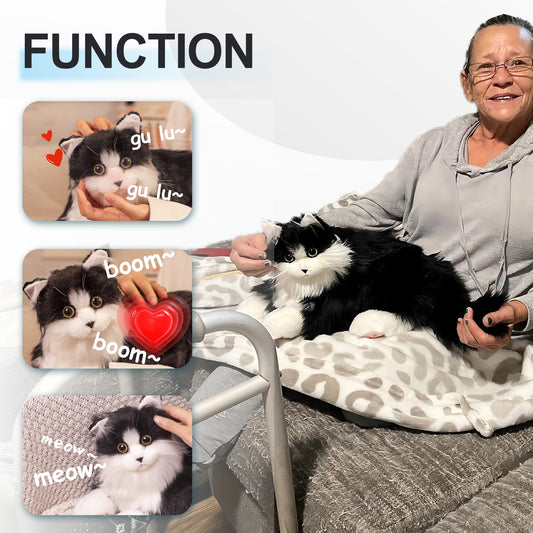
Percy isn’t an ordinary pet; he is an animatronic companion cat. With realistic synthetic fur, gentle blinks, and a soothing, rhythmic purr that vibrates right through a sweater, Percy was designed with one specific purpose: to bring calm to people living with Alzheimer’s disease and other dementias.
When sundowning sets in, when the world stops making sense, or when words fail and anxiety takes over, Percy doesn’t ask questions. He doesn’t test memory. He simply responds to touch with warmth and soft robotic murmurs. That tactile grounding often de-escalates agitation faster than a sedative, preserving peace and dignity when the disease is at its most relentless.
Tools like Percy represent the heart of responsive, non-pharmacological dementia care. But as comforting as an animatronic companion is, every time I see someone finding solace in Percy’s purr, I am reminded of a stark, urgent reality: we shouldn’t be waiting until someone needs a companion pet to intervene in their cognitive health.
This September, during World Alzheimer’s Month, we have to look honestly at both ends of the care continuum—from the gentle comfort tools that ease late-stage symptoms to the cutting-edge diagnostics that could prevent those symptoms from arriving so soon.
The Silent Window
For decades, Alzheimer’s was diagnosed by observation and exclusion: we waited for a person to repeatedly forget names, get lost on familiar routes, or struggle with routine tasks.
Today, science tells a completely different story. The underlying pathology—the accumulation of toxic amyloid plaques and phosphorylated tau tangles—silently takes root in the brain 15 to 20 years before a person ever misplaces a set of keys or repeats a question.
By the time outward symptoms become obvious enough to warrant a referral, significant neurological damage has already occurred. And in modern Alzheimer’s treatment, timing is everything. Newly approved disease-modifying therapeutics are designed specifically for people in the earliest stages: Mild Cognitive Impairment (MCI) or mild dementia. Once the disease progresses into moderate or advanced stages, the therapeutic window slams shut.
Early detection isn’t just about putting a label on a future condition; it is about buying time. It gives individuals the power to adopt aggressive brain-healthy lifestyle interventions, enroll in clinical trials, plan their legal and financial affairs on their own terms, and access treatments when they can actually slow the progression. (See last weeks essay on late-life wishes!)
The Policy Roadblock: Waiting for the Fire to Buy an Alarm
So why aren’t we routinely testing for Alzheimer’s before symptoms rob people of their autonomy?
The medical science has arrived. Simple, highly accurate blood biomarker tests can now detect Alzheimer’s pathology with a single vial of blood—bypassing the need for invasive lumbar punctures or expensive, hard-to-access PET scans.
The obstacle isn’t technology; it is policy.
Under current statutory law, Medicare generally only covers diagnostic tests when outward clinical symptoms are already present. The system is structurally designed to reimburse for the fire, not the smoke detector.
As a legislative advocate working to modernize Medicare coverage, this is the wall we run into every day. Telling older adults that they cannot get an FDA-cleared blood biomarker test covered until they are already symptomatic is a tragic Catch-22. If Medicare waits until memory loss is undeniable, it is denying beneficiaries the exact window where new treatments and early care plans can do the most good.
Advancing bipartisan legislation—such as the Alzheimer’s Screening and Prevention (ASAP) Act—is essential. It creates a statutory pathway for Medicare to cover routine, evidence-based blood screening tests, ensuring that breakthroughs in the lab actually reach the exam room without crushing out-of-pocket costs.
Bridging the High-Tech and the Heart-Centered
A complete vision of dementia care requires both ends of the spectrum:
-
At the bedside: We need empathy, sensory tools, and compassionate approaches—like Percy—that alleviate fear and honor personhood at every stage of cognitive change.
-
On Capitol Hill: We need proactive healthcare coverage that treats Alzheimer’s as a manageable biological condition rather than an inevitable diagnostic surprise.
World Alzheimer’s Month is a time for awareness, but awareness without advocacy is merely observation.
We can celebrate the warmth Percy brings to a weary afternoon while simultaneously fighting for the legislative change that keeps minds sharper, longer. Our loved ones deserve the comfort of a gentle companion when times get hard—but even more, they deserve a healthcare system that steps in while they still have years of clarity left to live.


