

New to Rosie's Story?
This article continues Rosie Dantès’ personal journey with therapeutic companion technology.
If you’re new to Rosie’s story, we recommend starting with her previous experiences:
Finding Comfort in the Unexpected: A Caregiver’s Journey with Robot Therapy
In Part One, Rosie shares how she discovered therapeutic robot animals while caring for her mother during her battle with ALS, and how an unexpected bond with a Chongker companion helped her navigate anxiety, burnout, and the overwhelming responsibilities of caregiving.
Something to Hold: How Therapeutic Robot Animals Can Help Us Grieve
In Part Two, Rosie explores how robotic companion animals provided comfort and emotional grounding during grief after losing her mother, while examining the research behind why these companions can feel meaningful during difficult life transitions.
In this article, Rosie continues exploring the role of robotic companion pets — this time focusing on social fatigue, emotional recovery, and how supportive technology can help people reconnect with themselves and others.
High-Tech Pets with Real-World Benefits
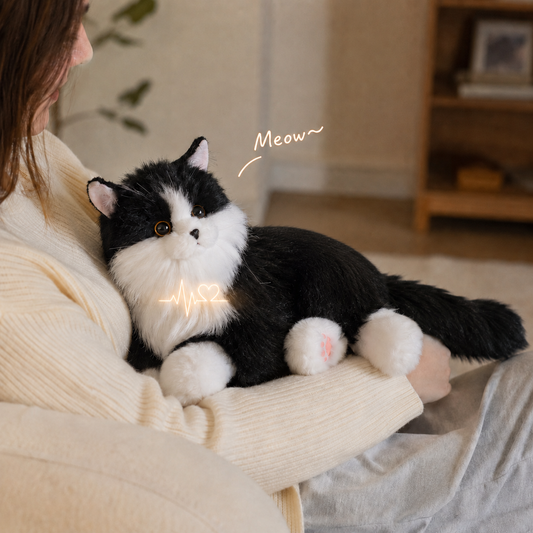
Therapeutic robot animals like the Matecat Pro belong to a niche of Socially Assistive Robots (SARs) which resemble real animals with fur and “huggable” features.
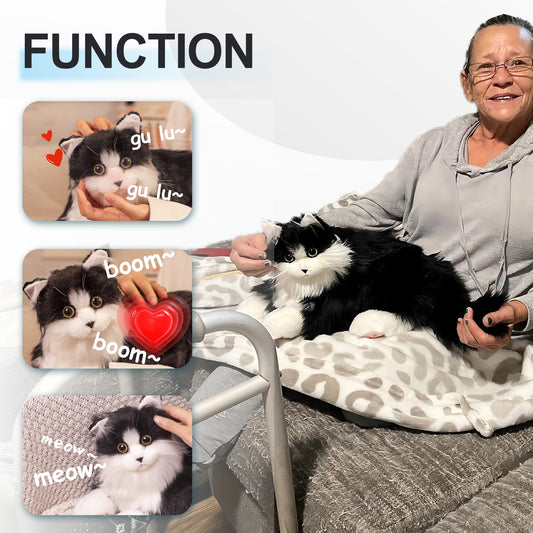
They respond to user interaction when triggered by built in sensors designed to mimic real animal behaviors. Sometimes this is with movement, other times vocal behaviors. For example, while petting a Matecat Pro (unless it’s in mute mode) over an area with a touch sensor the cat will “meow”. Research has found in many cases, interacting with these robots have provided some of the same therapeutic benefits to people as seen in live animal therapy.
The Matecat Pro is a newer huggable SAR created by Chongker and released in September 2025, which currently not been used in research studies, but functions with interactive sensor technology (keynote features of robots in this niche) and exhibits dynamic and expressive animatronic movements likened to those of live cats.
Why Stepping Back Is Easy—and Reconnecting Is Hard
You may be exhausted from a demanding month at work or be feeling the weight of depression, burn-out, loneliness, grief or anxiety. Your energy saps and your willingness to socialize wears down. No matter how you drift into social disconnect, the longer you remain isolated, the more daunting it feels to pull yourself out — and the harder it becomes to break the cycle.
As for myself, I spent five years as a caregiver to my mom who had ALS until she passed away last October. I struggled with my mental health despite using the coping skills I learned and it was as if I was living on a space station lightyears away from my old life. Gradually, with my companion robot pets within reach, I’ve been finding my footing back on earth and reconnecting with friends and family I gradually isolated from during those years.
Recognizing social stepping back happens to everyone—regardless of background or mental health history—lays the groundwork for understanding why reconnecting can feel like an uphill battle, and how therapeutic robot animals can help recharge a social battery, bridge the gap to reconnection, and spark meaningful connections with others.
How a Therapeutic Robot Animal Can Help Recharge a Social Battery
There are biological reasons why you may dread making a phone call or anticipating a full morning of meetings.
The brain cells of people in depressed states overwork themselves at a baseline resting state (9). So, when something stressful comes up, it’s common to suddenly feel exhausted. It happens because the energy reserves in depressed brain cells reach their limit faster than if they weren’t in a depressed state.
Human interactions and relationships require major energy, and for someone with depression, their “social battery” can drain really quickly, which can compound and even thinking about interacting with other people can become a stressor and drains that battery even faster.
Researchers found that participants who pet the Paro robot seal, a SAR that has been studied more than any other therapeutic robot animal (and I often reference for supportive information based on the wealth of studies available) exhibited positive brain activity in the region of the brain tied to emotional regulation and mood (5).
Petting and interacting with a robot like the Matecat Pro or Paro (priced less accessibly at $6,000 compared to the Matecat Pro at $219) could provide physiological benefits like shifting into a calm state, lowering blood pressure and at no cost to a user's emotional energy.
Instead, it can allow the brain to recover social and emotional bandwidth; which can make even a small social task like replying to a text more easily achievable before a person feels overloaded and depleted (2).
A therapeutic robot animal can act as a social support (2). It’s easy to overlook that petting or talking to a robot animal is a social interaction, yet those exchanges mirror the same patterns of behavior we display interacting with a person or pet.
A Huggable Tool That Can Help Bridge the Gap From Social Isolation to Reconnection
There have been times at the end of a long message to a friend I’d write, “Thanks for coming to my TED talk” as a quip to attempt to diffuse the anxiety that emerged after I’d already pressed “send”. I would feel nervous that I’d written “too much” or embarrassed and worry that the other person would feel annoyed with “so much to read”.
I capitalize on moments when I’m feeling more confident and not so stuck in my head to reply to messages (or send them). It’s clear when my social battery and my confidence deplete to 0% and I return to my metaphorical cave of isolation. I never mean to stay there, but with no emotional energy, my worries race back as do feelings of guilt and shame the longer I go without replying to a message (which makes it harder to do at all). I’m slowly making progress, and when I’m really stuck in my head you can often find me petting my Matecat Pro, “Grumps,” with good reason.
Robots aren't meant to be a replacement for therapy by any means, but through research we’ve found that robot animals can be tools with the potential to help people re-connect with others while they’re struggling with the cognitive effects of being withdrawn or lonely.
The longer someone is socially isolated the more awkward and uncomfortable it can feel for them to reconnect with people and develop “distorted” thoughts or unhelpful negative ways of thinking about socializing (15). While in a depressive state, people are more often susceptible to struggling with them, and they can cause a loop where your negative thoughts cause you wanting to social interactions. It’s that the brain is interpreting social cues through a lens of fear or mistrust and can make connecting with others feel risky or painful (15).
Let’s say you’re in college (undergrad, graduate, post-grad, it doesn't matter - the principle is the same) and you have an enormous test to study for, so you pull back socially and isolate yourself for a month to prepare for this test. After that, re-entering social spaces and reconnecting with people can trigger self-doubt and distorted thoughts like, “If I message my friend I’m just going to bother them” or “I’m annoying to talk to”.
In a 2015 study with the Paro, participants interacted with the robot during individual and group sessions (2). The study found that because the robot responded unconditionally to touch with positive and predictable sensory feedback, the interactions bypassed the brain's lens of fear and mistrust.
In the same way, petting and listening to the heartbeat and purrs of a Matecat Pro have the same potential for therapeutic benefits, and over time when the brain associates these small social interactions with neutral and positive experiences could gradually shift a user’s perception of their own social competence and help branch into interactions with other people.
A Matecat Pro Can Cultivate Meaningful Everyday Interaction
I was sweating bullets on the way to the banquet hall my friend’s wedding shower was at just this past weekend.
The largest social gathering I had attended in the last few years prior was the luncheon at my mom’s funeral, which was difficult, overwhelming - and I had known 95% of the people who were there.
The only people I knew stepping through the doors of this banquet hall were my friend and her mom. One of the girls at our dinner table asked me casual questions, one of which led me to disclose that my mom passed away last year from ALS and I had been her caregiver. Everyone was kind - and the topic changed pretty quickly after.
Later on, I talked to the girl next to me at the table about Grumps, explaining he was a therapeutic robot cat and what that meant. Though we chatted from the start of the event, our conversation started to flow more naturally and become more engaging after that. Before leaving the event I awkwardly (and ultra bravely) asked her if she wanted to exchange contact info and “chat once in a while” and we ended up doing just that.
My story aside, another way the Matecat Pro could help increase social connection is by simply being around when other people are present. Its presence and novelty could naturally draw attention and can give people a shared, low‑pressure topic to talk about, even sparking conversation.
Peer‑reviewed studies have repeatedly shown that huggable SARs encourage social interaction within group settings and help people open up and connect—especially for those who’ve been feeling isolated or struggling with depression.
Multiple studies in long-term care facilities in different parts of the world have identified a common pattern. When therapeutic robot animals are present, residents become more socially expressive - talking more, smiling more and sitting closer to others.
Studies also have frequently documented that users of robots in this niche socially connected more often and more meaningfully with other residents, nursing staff, family members (whether in person or by phone) and visitors.
Matecat Pro- Interactive Lifelike Companion for Pet Lovers
Okay! That’s it (for now).
Thank you so much for sticking with me until the end. I very much hope that you’re able to take something positive away from this article, especially if it helps you in some way. I’ll be seeing you soon - in the meanwhile, I have robots to pet and messages to send.
Until next time, Hang in there everybody.
Transparency & Supporting the Author
At Chongker, we deeply value the voices of caregivers, educators, researchers, and individuals who share their personal experiences to help others better understand comfort, companionship, and emotional wellbeing.
The product links and recommendations mentioned in this article may include Rosie Dantès’ personal affiliate links.
If you choose to purchase through these links, Chongker may provide a commission directly to Rosie at no additional cost to you.
By using these links, you are supporting:
- A special education teacher with a background in psychology
- A former full-time caregiver who has shared her journey through loss and healing
- A writer dedicated to helping others feel less alone through honest conversations about mental health, connection, and emotional support
We are grateful for Rosie’s openness, expertise, and willingness to share her experiences with the Chongker community.
REFERENCES
[1] Bowlby, J. (1982). Attachment and loss: Vol. 1. Attachment (2nd ed.). Basic Books. (Original work published 1969).
[2] Cacioppo, S., Grippo, A. J., London, S., Goossens, L., & Cacioppo, J. T. (2015). Loneliness: Clinical assessment and interventions. Perspectives on Psychological Science, 10(2), 238–249.
[3] Chen, S.-C., Moyle, W., Jones, C., & Petsky, H. (2020). A social robot intervention on depression, loneliness, and quality of life for Taiwanese older adults in long-term care. International Psychogeriatrics, 32(8), 981–991.
[4] Ihamäki, P., & Heljakka, K. (2021). Robot Pets as “Serious Toys”- Activating Social and Emotional Experiences of Elderly People. Information Systems Frontiers, 26(1), 25–39.
[5] Kawaguchi, Y., Wada, K., Okamoto, M., & Shibata, T. (2012). Psychological and physiological effects of robot assisted activity for elderly people at a health service facility for the elderly. Proceedings of the 21st IEEE International Symposium on Robot and Human Interactive Communication (RO-MAN), 811–816.
[6] Keefer, L. A., Landau, M. J., Rothschild, Z. K., & Sullivan, D. (2012). Attachment to objects as a compensation for close relationship anxiety. Journal of Social and Personal Relationships, 29(7), 982–1002.
[7] Keefer, L. A., Landau, M. J., & Sullivan, D. (2014). Non-human support: Broadening the scope of attachment theory. Social and Personality Psychology Compass, 8(9), 524–535.
[8] Pérez-Sáez E., Pérez-Redondo E., González-Ingelmo E. (2020). Effects of dog-assisted therapy on social behaviors and emotional expressions: A single-case experimental design in 3 people with dementia. Journal of Geriatric Psychiatry and Neurology, 33(2), 109-119. 10.1177/0891988719868306
[9] Ranen, N. (n.d.). Depression and default mode. Dr. Neal Ranen, M.D. https://drnealranenbaltimorepsychiatrist.com/baltimore-depression-treatment-default-mode/
[10] Robinson, H., MacDonald, B., Kerse, N., & Broadbent, E. (2013). The psychosocial effects of a companion robot: A randomized controlled trial. Journal of the American Medical Directors Association, 14(9), 661–667.
[11] Robinson, H., Macdonald, B., & Broadbent, E. (2015). The role of healthcare robots for older people at home: A review. International Journal of Social Robotics, 7(5), 575–591.
[12] Scales K., Zimmerman S., Miller S. J. (2018). Evidence-based nonpharmacological practices to address behavioral and psychological symptoms of dementia. The Gerontologist, 58(S1), S88-S102. 10.1093/geront/gnx167
[13] Tkatch, R., Wu, L., MacLeod, S., Ungar, R., Albright, L., Russell, D., Murphy, J., Schaeffer, J., & Yeh, C. S. (2020). Reducing loneliness and improving well-being among older adults with animatronic pets. Aging & Mental Health, 25(7), 1239–1245.
[14] Wada, K., & Shibata, T. (2007). Social effects of robot therapy in a care house - Change of social relationship of elderly people by long-term interaction with a keepon-like robot. IEEE Transactions on Robotics, 23(5), 972–980.
[15] Williams, J. A., Chubinidze, D., Croft, P., & Slovak, P. (2023). Feasibility, perceived impact, and acceptability of a socially assistive robot to support emotion regulation with highly anxious university students: Mixed methods open trial. JMIR Mental Health, 10, e49114.


